
The most important room in Five Nights at Freddy’s has never been a monster’s lair. It is a workplace. A security office, a hallway, a party room, a stage, or a storage area becomes frightening because it was designed for ordinary human use and then left behind. The franchise turns commercial architecture into a system of thresholds: places where safety ends, visibility fails, and something familiar can suddenly become hostile.
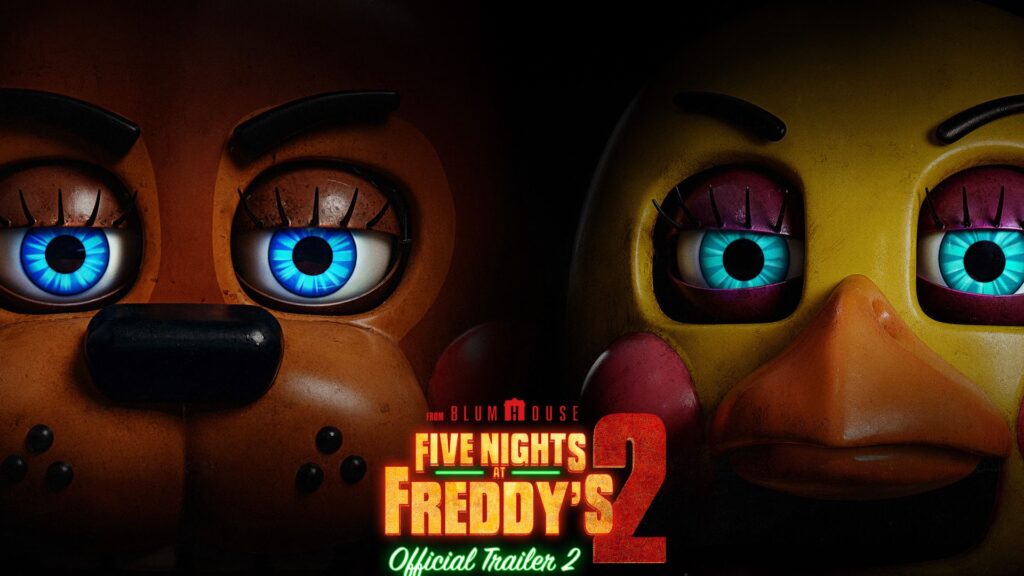
That idea remains useful when reading Five Nights at Freddy’s 2. Universal describes the sequel as taking place one year after the supernatural nightmare at Freddy Fazbear’s Pizza, when the tragedy has already been transformed into a campy local legend and a public Fazfest. Mike and Vanessa have hidden the truth from Abby, but Abby’s attempt to reconnect with Freddy, Bonnie, Chica, and Foxy exposes older secrets and a long-forgotten horror. The film was directed by returning filmmaker Emma Tammi and written by series creator Scott Cawthon.
The sequel therefore expands the franchise beyond one abandoned restaurant while preserving its architectural logic. Freddy’s is frightening because its spaces sit between identities. They are built for children but occupied by threats, designed for crowds but experienced in isolation, decorated for daytime celebration but explored after the social purpose of the building has disappeared.
Liminal horror begins when a place loses its expected purpose
A liminal space is often understood as a transitional environment: a corridor, lobby, waiting room, stairwell, parking structure, or other place meant to move people between destinations. Internet horror expanded the idea into images of spaces that feel strangely suspended: empty malls, fluorescent offices, deserted play areas, hotel corridors, and schools after hours. The discomfort comes from recognition without belonging. We know what the place is for, but the people and activity that normally justify it are missing.
Freddy Fazbear’s Pizza is almost ideal for this effect. Family restaurants are noisy by design. They contain music, conversation, arcade sounds, bright signage, food, birthday rituals, and constant movement. Remove the families and employees and the same decorations become evidence of absence. A smiling mascot on a stage no longer performs for anyone. A row of tables no longer promises a party. The building retains the visual language of happiness after happiness has left it.
This reversal is more powerful than simply placing a monster inside a dark warehouse. A warehouse is expected to be impersonal. A children’s restaurant is expected to be safe. Horror gains energy from the distance between what architecture promises and what the story makes it deliver.
Closed architecture turns movement into a survival decision
Good survival horror rarely gives characters unlimited movement. A frightening environment becomes dramatically useful when every route carries a cost. The audience should understand that going through a door solves one problem while exposing the character to another. A hallway offers distance but also creates a long line of approach. A room provides cover but can become a trap. A camera extends vision while narrowing attention to whatever appears on the screen.
The original Five Nights at Freddy’s 2 game made this principle unusually explicit. The player is largely fixed in a security office and must interpret cameras, vents, hallways, sound, light, and timing rather than simply run away. The movie does not need to reproduce those mechanics literally to inherit the same storytelling lesson: confinement makes geography meaningful.
Once the audience learns the map, tension can be created with very little. A previously empty doorway becomes occupied. A route that felt safe becomes unavailable. A familiar room is approached from an unfamiliar direction. Architecture becomes suspense because the viewer is constantly calculating where danger can enter.
Surveillance creates the illusion of control
Security cameras are central to the franchise’s identity because they create a cruel contradiction. Seeing more should make a character safer. In Freddy’s, seeing more often reveals how little control the observer actually has.
A surveillance feed divides space into fragments. The person watching does not experience the building continuously. They receive selected rectangles: one room, one angle, one moment. Everything between those rectangles becomes uncertain. That uncertainty is where horror lives. If a figure disappears from one camera, the frightening question is not merely where it went. The question is which unseen route connects its previous location to yours.
For writers, this is an important technique. Information can increase tension when it is incomplete. Showing the audience a threat does not necessarily reduce fear if the story simultaneously removes the ability to track its movement. Surveillance converts knowledge into responsibility: now that the character knows something is coming, every second spent looking in the wrong direction matters.
Thresholds are more frightening than rooms
Doors, curtains, vents, corners, and dark hallway openings work because they divide known space from unknown space. A monster standing in the center of a brightly lit room is a fact. A monster that may be behind a threshold is a possibility, and possibility forces the audience to participate.
Mascot horror benefits especially from this structure. Animatronics are large, recognizable objects. If they remain visible for too long, the viewer can study them and become accustomed to their shape. Architecture repeatedly hides and reveals them. A doorway can reduce a detailed creature to two eyes, a silhouette, a piece of metal, or the suggestion of movement. The building edits the monster before the camera does.
Fazfest adds another layer of liminality
The sequel’s official premise adds an interesting social transition: the original nightmare has become folklore. The town turns the story into Fazfest, converting trauma into entertainment. That transformation creates a second kind of liminal space, not just architectural but cultural. Freddy’s exists between crime scene and attraction, memory and merchandise, warning and celebration.
This matters because horror franchises often struggle once characters know the monster is real. Public disbelief can become repetitive. By turning the past into a local legend, the story creates a more uncomfortable condition: people may know the story and still fail to understand it. Familiarity becomes camouflage. The imagery of Freddy’s can circulate openly because the community has decided it is fiction, exaggeration, or fun.
The result echoes the franchise’s architectural trick. Just as a party room can look safe while functioning as a trap, a festival can look like communal memory while functioning as collective misreading.
How writers can make a setting dictate the rules of survival
The most useful lesson from Freddy’s is that setting should not be interchangeable. If the same scene could happen in a house, hospital, warehouse, or forest without changing its logic, the environment is probably decoration rather than story structure.
- Give every safe area a weakness. Safety should be conditional rather than absolute.
- Limit information by architecture. Walls, cameras, doors, vents, noise, and lighting should determine what characters can know.
- Make routes carry consequences. Moving toward one objective should mean abandoning another advantage.
- Corrupt the building’s original purpose. The strongest unease comes when the audience can still recognize what the space was supposed to provide.
- Teach geography before breaking it. Once viewers understand the normal map, a blocked corridor or occupied doorway becomes meaningful.
This is why liminal horror is not simply an aesthetic of empty hallways. Its real narrative power comes from suspended function. The building still looks like a place where ordinary life should happen, but ordinary life has been interrupted. The audience is left inside the gap between the two states.
Freddy’s is a machine for turning familiarity into threat
The animatronics may be the faces of Five Nights at Freddy’s, but architecture gives those faces their power. A mascot is disturbing because it waits at the end of a hallway that should lead to a birthday party. A camera is frightening because it shows an empty room that was occupied seconds ago. A locked office is comforting until the audience understands how many openings surround it.
That is the deeper discomfort of the franchise’s liminal spaces. They do not transport us somewhere completely alien. They leave us inside recognizable places after their social rules have stopped working. Survival begins when the characters accept that the architecture no longer means what it used to mean.
For more stories about familiar environments becoming hostile, explore Raphael T. Maio’s books and the microfiction archive.