
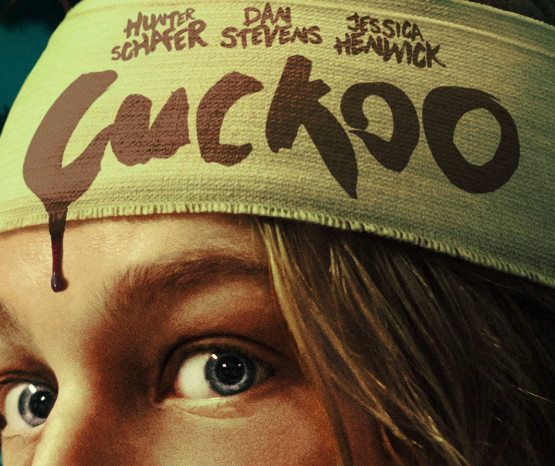
Cuckoo becomes much easier to understand once its title is treated as a biological instruction rather than an eccentric label. The film’s central creature mythology is inspired by the reproductive behavior of cuckoo birds, which can place their eggs in the nests of other species and leave those hosts to raise the offspring. Writer-director Tilman Singer has said that a documentary about cuckoo breeding helped trigger the idea for the film. What interested him was not only the parasitic strategy, but the strange emotional image of host parents continuing to care for a chick that is not biologically theirs.
Singer then made a crucial storytelling choice. Instead of building the movie around the mother of a threatening child, he became interested in the sibling who already occupies the nest. In nature, cuckoo chicks can gain an advantage over the host’s offspring; Singer described realizing that being the sibling inside that nest could be the more disturbing perspective. That idea becomes the emotional key to Gretchen, the seventeen-year-old protagonist played by Hunter Schafer.
NEON’s official synopsis places Gretchen in the German Alps after she leaves America to live with her father and his new family. She is already grieving her mother and entering a household in which she feels displaced. Strange noises and bloody visions eventually expose a secret connected to the family around her. The creature plot therefore does not interrupt Gretchen’s family crisis. It gives that crisis a biological form.
Brood parasitism becomes a rule of horror
The real-world cuckoo reference matters because it gives the film a coherent metaphor. Brood parasitism does not require a predator to destroy a nest from outside. The reproductive strategy works by entering an existing system of care and redirecting that care toward another offspring. The nest remains a nest. Feeding remains feeding. Parenting remains parenting. What changes is who benefits.
That is much closer to Gretchen’s emotional problem than a conventional monster attack would be. She does not arrive in a family that openly rejects the concept of family. She arrives in a reorganized family. Her father has a new wife, Beth, and Gretchen has a younger half-sister, Alma. The domestic structure still exists, but Gretchen is unsure where she belongs inside it.
The film’s speculative biology magnifies that fear. Replacement stops being only an adolescent feeling and becomes something the world of the story can physically enact. The question “Has my family moved on without me?” is transformed into the more grotesque question “What if family itself can be biologically hijacked?”
The monster is frightening because reproduction is its objective
Many horror creatures pursue simple goals: eat, kill, infect, possess, or defend territory. Cuckoo is stranger because its threat is organized around continuation. The creature’s behavior belongs to a reproductive system. That gives the horror an unsettling logic. Violence is not necessarily the final objective; violence protects a cycle.
This distinction is important in creature writing. A monster becomes more believable when its frightening behavior appears to serve a consistent need. The audience does not need a scientific textbook explaining every mechanism. It needs enough repeated cause and effect to recognize that the creature is not improvising according to the screenplay’s convenience.
Singer’s cuckoo inspiration supplies exactly that foundation. The creature mythology revolves around intrusion into another reproductive and family structure. The human characters who try to preserve or exploit that cycle become part of the horror because they turn biological compulsion into an organized project.
Sound makes biology feel like a physical law
The film repeatedly connects its threat to sound, perception, and bodily disruption. This is one reason the creature feels less like a person in makeup and more like an organism with abilities that humans are not equipped to process normally. The strange vocalization is not merely an atmospheric noise added after the fact. It functions as part of the creature’s presence and power.
For science-fiction horror, this is a useful technique. A biological rule becomes convincing when it has sensory consequences. If a species possesses an unusual reproductive strategy, hunting method, or communication system, the story should allow characters to experience that difference through the body. Hearing, balance, memory, pain, vision, or orientation can become interfaces between human perception and alien biology.
In Cuckoo, sound helps create a world in which the threat does not have to be fully visible to control a scene. The audience can recognize the beginning of danger before it understands the complete mechanism. That gap between recognition and explanation produces dread.
The body becomes evidence
Body horror is most effective when physical abnormalities reveal something the characters would rather keep hidden. The body is harder to negotiate with than dialogue. A character can lie about motives, deny a family secret, or reinterpret a memory. A biological reaction insists that some rule exists whether anyone wants to acknowledge it or not.
That makes reproductive horror particularly invasive. Pregnancy, inheritance, kinship, and development already involve processes that cannot be reduced to conscious choice. A speculative creature can exaggerate those processes until the body appears to belong partly to a larger cycle. Individual autonomy collides with species-level continuation.
Gretchen is the sibling in the wrong nest
Singer’s comments about approaching the idea from the sibling’s perspective are essential because they prevent the film’s metaphor from collapsing into a simple fear of motherhood. Gretchen’s crisis is about displacement. She is grieving one family structure while being asked to inhabit another. She is old enough to recognize the emotional changes around her but young enough to remain dependent on the adults making those changes.
Her relationship with Alma complicates the metaphor in the best way. If the story treated the younger sibling only as a rival, the cuckoo symbolism would be obvious but emotionally thin. Instead, the danger forces Gretchen to confront a more difficult truth: feeling replaced by someone does not mean that person is responsible for replacing you.
That distinction turns the coming-of-age story away from competition and toward chosen responsibility. Gretchen’s maturity is not measured by accepting every decision made by the adults around her. It is measured by her ability to recognize a bond that matters even when the structure surrounding that bond is painful and compromised.
Mr. König turns nature into ideology
The presence of Mr. König, played by Dan Stevens, gives the film another layer. A creature following a reproductive imperative is disturbing, but a human being deciding that the cycle deserves preservation transforms natural horror into ethical horror. The problem is no longer simply what a species does. It is what people are willing to do once they decide that the species, experiment, bloodline, or discovery matters more than individual consent.
This is a recurring strength of science-fiction horror. Nature can establish the rule, but human obsession can industrialize it. A dangerous organism may have limited reach on its own. The moment a person builds facilities, routines, secrecy, and protection around it, the threat gains infrastructure.
The Alpine resort therefore becomes more than an isolated location. It is a controlled habitat where ordinary hospitality conceals another purpose. Guests, families, rooms, and routines can all be interpreted through the hidden reproductive project beneath them.
The rules work because they mirror the theme
Creature rules are often treated as plot mechanics: sunlight kills the vampire, silver harms the werewolf, noise attracts the alien. The strongest rules do more. They express what the story is about.
- Reproduction mirrors replacement. The biological cycle externalizes Gretchen’s fear that a new family has occupied her old emotional position.
- Brood parasitism complicates parenthood. Care can be genuine even when the biological arrangement behind it is strange or manipulated.
- Sound destabilizes perception. Gretchen cannot rely on ordinary sensory certainty, just as she cannot rely on the adults around her to explain what is happening.
- Human preservation turns instinct into a system. The horror expands when people decide to maintain the cycle deliberately.
- Siblinghood challenges pure biological logic. Emotional bonds can become meaningful even inside a family structure built on secrets and displacement.
These connections are why the movie can remain strange without becoming arbitrary. Not every detail needs a literal one-to-one symbolic translation. The rules orbit the same emotional center: who belongs in a family, who decides that belonging, and whether biology has the final word.
The ending turns belonging into a choice
The film’s reproductive mythology initially makes family feel deterministic. Bodies, bloodlines, instincts, and hidden biological processes appear to decide who belongs to whom. Gretchen’s arc pushes against that determinism. The emotional resolution matters because she can act toward another person as family rather than merely accept the family structure handed to her.
That is what makes Cuckoo more than a creature puzzle. Its science-fiction biology creates a world in which reproduction can invade identity, but the protagonist’s growth depends on separating biological circumstance from emotional responsibility. The horror says that bodies can be manipulated. The coming-of-age story asks whether care can still be chosen.
Singer found horror in the cuckoo’s nest, but he also noticed something unexpectedly hopeful in the natural image that inspired him: a host continuing to care for an offspring that did not originate there. That contradiction survives inside the film. The same reproductive strategy can symbolize intrusion and reveal that family is not reducible to genetic ownership.
For more fiction about unstable identities, family secrets, and the familiar becoming wrong, explore Raphael T. Maio’s books and the microfiction archive.