
“`html
The most important clue to understanding the creatures in The Last House is that they are not really invading Earth. According to director Louis Leterrier, they are ancient ocean dwellers that existed long before humanity. From their perspective, humans are the newcomers who damaged a world that was never exclusively ours.
That changes the meaning of almost everything that happens. The rain, the sealed houses and even the apparent attacks can be read less as the beginning of an alien conquest and more as a violent correction of the relationship between humanity and the planet.
The film still leaves important rules unexplained. We never receive a technical explanation for how doors and windows become impossible to open, exactly how the creatures coordinate the phenomenon, or whether every surviving community experiences the same thing. But the filmmakers have revealed enough to separate what is confirmed from what remains theory.
What are the creatures in The Last House?
The creatures are ancient beings from the ocean. They are not extraterrestrials arriving on Earth for the first time.
Leterrier describes them as inhabitants that were present long before humans. This also explains why their bodies are difficult to classify. Their design does not correspond neatly to a squid, jellyfish, octopus or any other familiar animal. Production designer Kevin Jenkins deliberately kept the anatomy ambiguous so that the audience could recognize something marine without completely understanding what it was looking at.
That ambiguity matters. If the creatures looked like an easily identified animal, the mystery would become biological: we would simply ask what species they were. Instead, they feel like representatives of an entire part of the planet that humanity has never fully understood.
Why did the creatures appear only now?
This is one of the questions the director answers most directly.
Humanity’s overconsumption, pollution and rising global temperatures have damaged the oceans badly enough that the creatures finally emerge from the depths. In other words, the timing is not random. Humanity crosses a threshold.
This also means describing the event simply as an “attack” misses part of what the film is doing. From the human characters’ point of view, it is obviously terrifying and destructive. From the creatures’ point of view, however, it appears closer to reclamation.
Leterrier explicitly reverses the traditional invasion story: humans initially assume that something has arrived to take their planet, but the revelation is that humanity has been behaving as though an already inhabited world belonged only to us.
The creatures may have been tolerating humanity until a limit was reached
One possible interpretation goes slightly beyond what the film confirms: these beings may have been aware of humans for centuries without considering intervention necessary.
If that reading is correct, the events of the movie begin not because the creatures suddenly become aggressive, but because the ecological damage reaches a level at which remaining hidden is no longer possible. Humanity does not discover them. Humanity forces them to respond.
Why do they trap people inside their houses?
This is where The Last House becomes more interesting than a conventional creature feature.
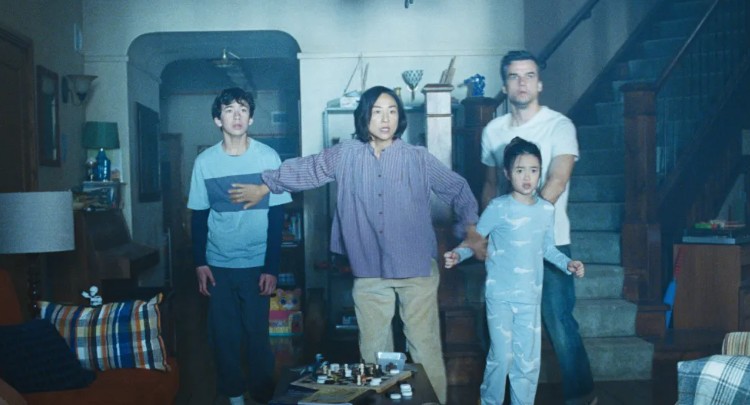
The houses do not appear to function simply as cages designed to slowly kill the occupants. If extermination were the objective, the creatures possess much simpler ways of achieving it. Instead, the Delgados are kept alive long enough to spend more than five years adapting, cooperating, fighting, growing food and gradually changing the way they understand their situation.
Leterrier says the creatures want humanity to learn to live together rather than continue trying to dominate both one another and the natural world. The confinement therefore resembles a forced lesson in coexistence.
Theory one: the houses are a behavioral test
The film never explicitly says that the Delgados are participating in a formal experiment. Calling it an experiment would therefore go too far.
But the ending strongly supports a test-like interpretation. The family remains imprisoned while Jason responds to the unknown primarily through control, defense and violence. When Ruth convinces him that the creature may be communicating rather than merely attacking, he changes his behavior.
Only then are they released.
The important distinction is that the creatures may not be testing intelligence, strength or survival ability. They appear to be testing whether humans can encounter another form of life without immediately trying to control or destroy it.
Theory two: humanity is being placed in the position of a captive species
There is another possible reading of the houses that fits the film’s ecological reversal particularly well.
Humans spend the story enclosed in tiny artificial environments while an incomprehensible species controls what exists beyond the walls. The arrangement effectively reverses humanity’s usual position. The dominant species becomes the confined one.
The house gradually stops feeling like protection and starts feeling like an enclosure. Meanwhile, the outside world — something humans normally assume belongs to them — becomes inaccessible.
Under this interpretation, the punishment is not merely losing freedom. It is being forced to experience what it means to exist entirely at the mercy of another species.
Theory three: the creatures are separating humanity into small survival units
The film also raises a more practical possibility. By isolating people inside individual homes and buildings, the creatures eliminate many of the larger systems humans rely upon: mass transportation, commercial supply chains, governments, armies and organized industrial activity.
What remains is the smallest social structure available to the Delgados: the family.
This reading is not confirmed as part of the creatures’ literal strategy, but it fits the movie’s structure. Humanity is stripped of the machinery that allowed it to dominate the planet and forced to rediscover cooperation at a much smaller scale.
Are the creatures actually trying to kill the humans?
They are unquestionably dangerous. But the ending makes a purely extermination-based explanation difficult to defend.
If their objective were simply the destruction of humanity, Jason’s decision to spare one creature should make no difference. Instead, that moment changes the relationship between the two species. The creature opens the way out and the Delgados are allowed to leave.
That suggests the violence in the film is partly reactive. Humans interpret the unknown as a predator and respond aggressively; the creatures respond in turn. Ruth is the first character able to interrupt that cycle.
It does not make the creatures benevolent. Forcing families into years of extreme confinement is hardly an act of kindness. The more useful distinction is that their objective seems to be change rather than simple extinction.
Why does Ruth understand the creatures?
Ruth can initially look like the familiar horror character who possesses a supernatural connection with the monster. Her drawings and observations seem to place her one step ahead of everyone else.
But Leterrier has said that her understanding is not meant to be supernatural.
Ruth is simply more open to interpreting the situation without the assumptions controlling the adults. Jason sees a threat and immediately asks how to defend his family from it. Ruth asks a different question: What if it is trying to tell us something?
That difference becomes essential. She succeeds not because she knows more facts about the creatures, but because she is willing to consider a possibility the adults have excluded.
Why does sparing the creature free the family?
This is probably the clearest evidence for what the confinement is actually about.
Jason spends most of the film trying to solve danger through action: repair the problem, create a system, build a defense, find a weapon, defeat the threat. Those instincts help keep his family alive, but they also prevent him from recognizing that not every unknown thing can be understood through domination.
When he finally trusts Ruth and refuses to kill the creature, he demonstrates something different. He accepts coexistence without having complete information.
The family is released because, according to Leterrier’s explanation, they have understood what the creatures were trying to teach humanity.
That does not mean they suddenly understand the creatures themselves. They understand the required behavior.
What the film still refuses to explain
Knowing the creatures’ thematic purpose does not explain every part of their biology or abilities. Several questions remain genuinely open.
- What physically seals the houses? The invisible barrier is never given a scientific mechanism.
- Do the creatures create the rain? The connection is clear, but the precise process remains unexplained.
- How coordinated is the event? We do not know whether the species acts collectively, possesses a hierarchy, or communicates across enormous distances.
- Is every human being being judged in the same way? The Delgados’ experience cannot automatically be applied to every survivor.
- What happens to people who refuse coexistence? The movie shows what happens to one family that eventually changes, not the complete fate of humanity.
Those are unresolved questions rather than necessarily contradictions. The film gives the creatures a motive without providing a complete rulebook.
The most convincing explanation changes who the monster is
The simplest interpretation of The Last House is therefore also the one that changes the movie most dramatically.
The creatures were already here. They emerge because humanity has damaged their environment. They trap people not merely to hunt them, but to impose a radical interruption on the way humans occupy the planet. And the Delgados are released only when they demonstrate that contact with another species does not have to end in domination and violence.
The unanswered question is not really where the creatures came from. We already have that answer: the ocean.
The more disturbing question is how long they had been watching humanity damage the surface before deciding that hiding was no longer an option.
What is confirmed and what is interpretation?
The creatures’ ancient ocean origin, the environmental reason for their emergence, Ruth’s non-supernatural intuition, and the coexistence message behind the family’s release are supported by comments from director Louis Leterrier published by Netflix. The behavioral-test, captivity-reversal and social-isolation readings above are interpretations based on those confirmed elements rather than additional canon.
Official reference:
Netflix Tudum’s ending explanation for The Last House
.
“`