
“`html
The central message of Hokum is that causing harm does not automatically make someone irredeemably evil, but refusing responsibility can. Beneath the haunted hotel, Irish folklore, distorted visions, and supernatural punishment, the film draws a careful line between guilt, accountability, and deliberate cruelty.
Ohm Bauman has spent most of his life believing that one terrible childhood accident defines everything he is. His personality, his writing, and even the violent ending of his Conquistador trilogy have been shaped by that belief. The night at Bilberry Woods Hotel forces him to confront a possibility he has never permitted himself to consider: he may be responsible for a tragedy without being a monster.
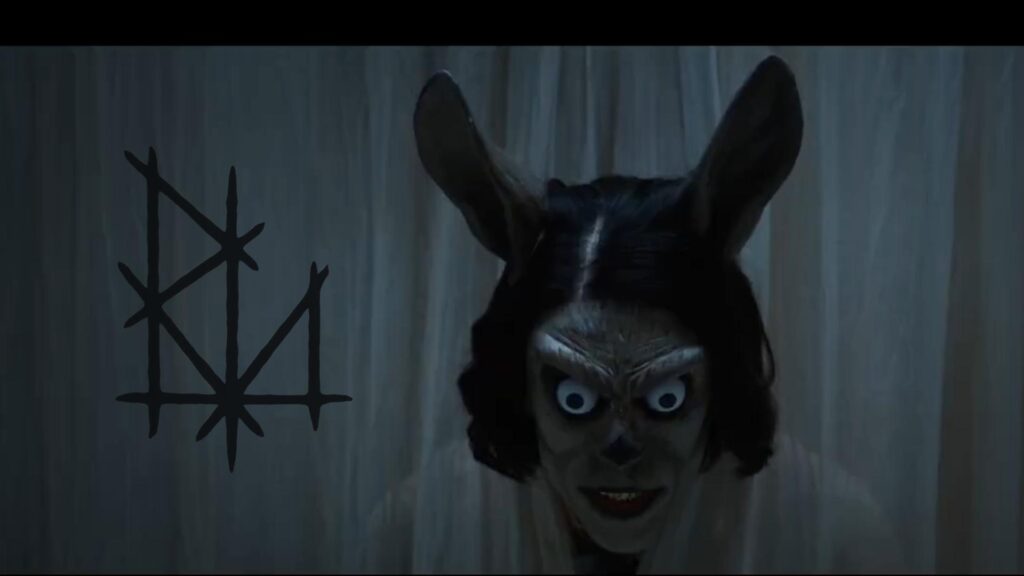
Written and directed by Damian McCarthy, the 2026 supernatural horror film follows Ohm, played by Adam Scott, as he travels to an isolated Irish hotel to scatter his parents’ ashes. The journey gradually becomes an investigation involving a missing employee, a sealed honeymoon suite, and a witch said to lead the guilty into the underworld. The premise is presented in the film’s official synopsis, but the meaning of the story only becomes clear when Ohm’s past and the fate of Fiona are revealed.
Guilt is not the same as evil
Ohm is introduced as arrogant, dismissive, and needlessly cruel. He belittles the hotel employees, rejects local stories as meaningless superstition, and treats the people around him as though they exist beneath his attention. The film initially gives the audience several reasons to dislike him.
This reaction is intentional. McCarthy has explained that he wanted viewers to begin the film hoping Ohm would be punished, then gradually reconsider that judgment as the source of his behavior became visible. Ohm’s hostility does not disappear, and the film does not excuse it. Instead, it asks whether understanding someone’s pain should change how completely we condemn them.
The distinction becomes essential when the film contrasts Ohm with Mal. Both men are connected to the death of a woman. Their moral positions, however, are radically different.
- Ohm caused an accidental death as a child and has spent decades consumed by guilt.
- Mal deliberately harmed Fiona and then attempted to conceal what he had done.
- Ohm eventually faces the truth, while Mal continues trying to escape it.
The film’s moral argument is therefore not that suffering makes a person innocent. It is that intention, remorse, accountability, and the willingness to change all matter when judgment is passed.
The Conquistador is Ohm’s private executioner
The fictional Conquistador story shown at the beginning and end of Hokum is not merely a secondary plot. It is the clearest representation of how Ohm sees himself.
In the original ending of his book, the Conquistador turns against the child traveling beside him. The scene reflects Ohm’s belief that violence is inevitable and that damaged people eventually destroy whatever remains vulnerable around them. It is a bleak ending because Ohm has already decided that mercy would be dishonest.
One possible reading is that the two characters represent opposing parts of Ohm:
| Story element | Possible meaning |
|---|---|
| The Conquistador | The adult Ohm who has accepted a monstrous identity and believes punishment is unavoidable. |
| The child | The frightened child Ohm once was, still trapped inside the moment that shaped his life. |
| The threatened violence | Ohm’s belief that either the guilty person or the innocent child must be destroyed. |
| The final embrace | The possibility that accountability and compassion can exist without revenge. |
After surviving the hotel, Ohm rewrites the ending. The Conquistador no longer simply destroys the child. He offers himself for punishment, but the child refuses to continue the cycle and embraces him instead.
This is the emotional resolution of the film. Ohm is not pretending the past never happened. The Conquistador still acknowledges guilt, and the child still carries the consequences. What changes is the assumption that punishment is the only honest response.
The witch judges what people choose to become
The witch can be interpreted as a supernatural judge, but she is not a simple symbol for Ohm’s guilt. The film repeatedly suggests that she has an existence independent of his mind. Her chains leave physical evidence, she affects other people, and Mal disappears after being taken by her.
Her judgment also appears selective. She threatens Ohm, but he is ultimately allowed to escape after confronting his past and accepting his mother’s forgiveness. Mal, who knowingly harmed Fiona and continued committing violence to protect himself, is taken instead.
This suggests that the witch does not merely punish anyone associated with death. She exposes the difference between a person imprisoned by remorse and a person who treats others as disposable.
McCarthy has also identified violence against women committed by cowardly men as a recurring fear in his films. In Hokum, supernatural evil may be frightening, but the most morally corrupt act is entirely human: Mal’s decision to sacrifice Fiona’s life to preserve his own reputation.
Fiona gives Ohm a chance to become different
Fiona’s role is larger than that of a missing person whose fate begins an investigation. She shows compassion to Ohm when he has done little to deserve it. Later, searching for the truth about her becomes the first significant action he takes for someone other than himself.
Ohm cannot save Fiona, but he can refuse to let Mal erase her. By following the clues she leaves behind, exposing the crime, and surviving long enough for the truth to emerge, he begins acting against the selfishness that previously defined him.
Redemption in Hokum is therefore not achieved through a single apology. It begins when Ohm accepts responsibility for what he can still do in the present.
Ohm’s mother breaks the chains guilt created
Throughout the film, Ohm’s memories of his mother are distorted by terror. He does not remember her simply as someone he loved. He remembers her through the worst moment of his childhood, allowing that moment to replace the entire relationship.
When her spirit finally appears without the threatening distortions created by his fear, she does not condemn him. Her presence offers the forgiveness he has spent decades refusing to imagine.
The chains surrounding Ohm are both supernatural restraints and a visible expression of his internal condition. Escaping them does not mean forgetting his mother. It means refusing to use her death as proof that he deserves no future.
Was the supernatural real or a hallucination?
The late revelation that Ohm unknowingly consumed a hallucinogenic substance appears to offer a rational explanation for the night. The film immediately complicates that explanation, however. Marks remain on his wrists, Fiona’s body is discovered, Mal is missing, and several events cannot be reduced comfortably to one person’s altered perception.
McCarthy has confirmed that some visions are hallucinations while others are intended to be real. In an interview about the ending, he explained that viewers can examine whether an apparition is reflected in Ohm’s glasses when the camera returns to him.
The ambiguity therefore does not mean that nothing happened. It asks a more interesting question: can an unreliable perception still reveal something true?
Ohm may not see every figure exactly as it exists, but the experience exposes facts he has avoided. The altered visions give form to his guilt, while the physical evidence prevents the audience from dismissing the entire supernatural world as fantasy.
Why the title Hokum matters
“Hokum” refers to something considered nonsense, deception, or empty theatrical invention. It describes Ohm’s initial attitude toward the hotel’s folklore. He writes horror stories for a living but assumes that the stories told by the local community are foolish performances for children and tourists.
His mistake is not simply failing to believe in a witch. He dismisses every form of knowledge he cannot control. Local memory, emotional intuition, folklore, grief, and compassion are all treated as inferior to his own cynical interpretation of events.
By the end, the supposedly ridiculous story has revealed more truth than Ohm’s carefully constructed public identity. The celebrated author understands fictional monsters, yet he has failed to understand the frightened child still shaping his life.
The ending offers redemption without erasing responsibility
Hokum does not end by declaring Ohm innocent of every failure. He has hurt people, hidden behind arrogance, and used his suffering as permission to remain emotionally distant. What changes is his belief that change would be dishonest.
He agrees to read Alby’s manuscript after previously humiliating him. He rewrites his own story with a more hopeful conclusion. These are modest actions, but that is precisely why they work. The film does not transform Ohm into a different person overnight. It shows him making his first choices outside the identity guilt constructed for him.
The witch delivers judgment, but Ohm’s mother offers something more difficult: mercy. To accept it, Ohm must acknowledge both the tragedy he caused and the fact that the frightened child responsible for it was not acting with cruelty.
That is the message left behind after the hotel burns. A person cannot rewrite the past, but the story built around that past can change. Guilt may preserve the memory of harm, yet when guilt becomes an identity, it stops producing responsibility and begins producing another kind of destruction.
Readers interested in stories where psychological wounds, supernatural uncertainty, and familiar places begin to turn hostile can explore Raphael T. Maio’s microfiction archive or discover the psychological horror novel Orto.
“`