The first strange thing that day was the silence.
Not the ordinary silence of the open sea, broken by wind or seabirds, but a heavy silence, almost viscous, as if the very air were waiting for something. Still, none of us commented. In Pomole, fishermen learn early that the sea does not like questions.
There were five of us. We left before sunrise, as always, but we did not head toward the familiar fishing grounds. For weeks, people had been talking about a more distant spot, a stretch of water where fish appeared in absurd quantities, even out of season. A place that “didn’t show up on maps,” they said, yet everyone seemed to know it by hearsay.
It took longer to reach. So long that when we finally cut the engines, there was no sign of the coast anymore. Only water in every direction, too flat, too still.
The fishing was immediate. The fish bit as if they had been starving for centuries. We laughed, drank, let time slip away. No one noticed when the current changed. No one felt the drift. We only realized something was wrong when one of the men pointed toward the horizon and asked where the city lights had gone.
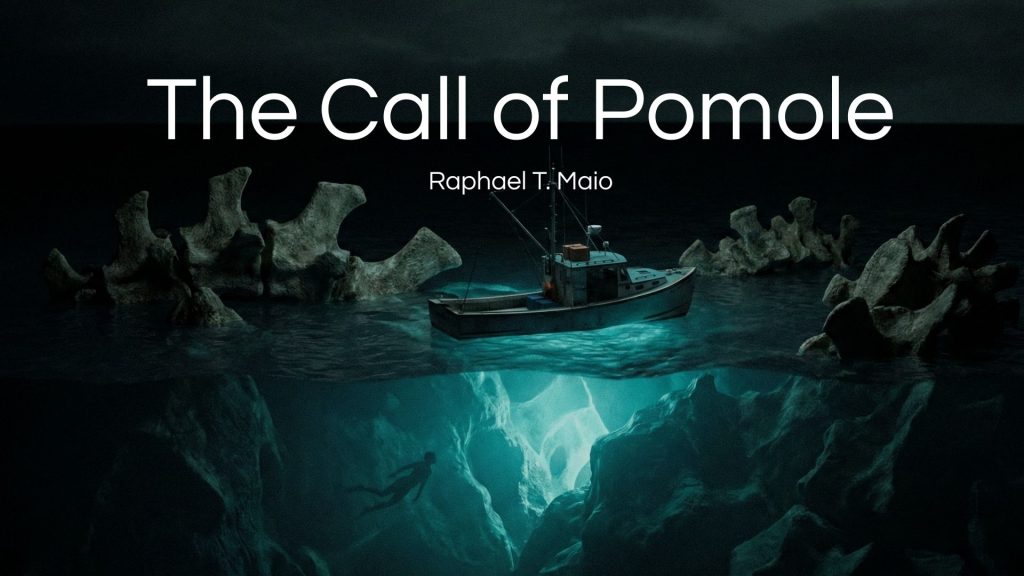
That was when we saw the rocks.
They should not have been there. Not that far out. Not like that. They rose from the water like ancient vertebrae, black and slick, forming an irregular arch. The tide began to recede in a way that felt wrong, far too fast, as if it were being drained.
As the water pulled back, something glimmered between the stones.
It was not metal. It was not coral. It was a motionless mass clinging to the seabed, pulsing with a pale blue green light, like a living organ breathing slowly. It did not move. It did not respond to the waves. It seemed to be waiting.
One of us, the most experienced diver, put on his gear without a word. He only said he was going to “take a look.” We watched his body vanish into the murky water, swallowed by that unnatural glow.
He never came back.
We waited. We called out. We shouted. The light kept pulsing. The tide kept falling. Then the hull of the boat scraped against stone. The impact was sharp. Final.
Where there had once been deep water, exposed rock formations now emerged, revealing something impossible: a dark opening between the stones, wide enough for a man to pass through.
Near the entrance, we found part of his diving equipment. Torn. Abandoned. Dragged inward.
We went in.
The interior did not resemble an ordinary cave. The walls were damp, but not cold. They had an organic texture, like petrified flesh. The ground yielded slightly beneath our feet. From deeper inside, a sound began to impose itself, a low, slow chant, impossible to identify as animal or mechanical.
The farther we advanced, the more of those luminous masses appeared, clinging to the walls and ceiling, pulsing in the same rhythm. Some were empty. Others were not.
We found our friend’s body trapped inside a translucent, aqueous structure, like a living cocoon. His eyes were open. He was breathing, but unresponsive. Something moved within that membrane, shaping him from the inside, consuming him with an almost ritual delicacy.
That was when we realized we were not alone.
She emerged from the darkness like a submerged bride. Her upper half vaguely resembled a woman: an elongated face, eyes far too deep, adorned with filaments that resembled veils. Her lower half was something between a fish and a seahorse, articulated in an impossible way, supported by pulsating membranes.
There was no hostility. There was invitation.
Two of my friends dropped to their knees. They wept. They murmured words they did not know. They spoke of ancient tides, of an oceanic womb, of a call that had always existed beneath Pomole.
I ran.
I stumbled back through the cavern as the chant grew louder, reverberating in my bones. Behind me came the sound of bodies dragging themselves forward, not in pursuit, but in devotion.
I managed to free the boat just as the tide began to rise again, as if nothing had happened. As I pulled away, I watched the rocks slowly sink beneath the water. The light faded.
When I reached the shore, Pomole was still asleep.
I never told the authorities everything. I never returned to that stretch of sea. But sometimes, at night, when the tide recedes too far, I hear the chant.
And I know they are still there, waiting for the next call.
This horror story is part of a larger universe of sobrenatural and psychological terror, connected to my other livro projects.
Short Tales
The Call of Pomole