
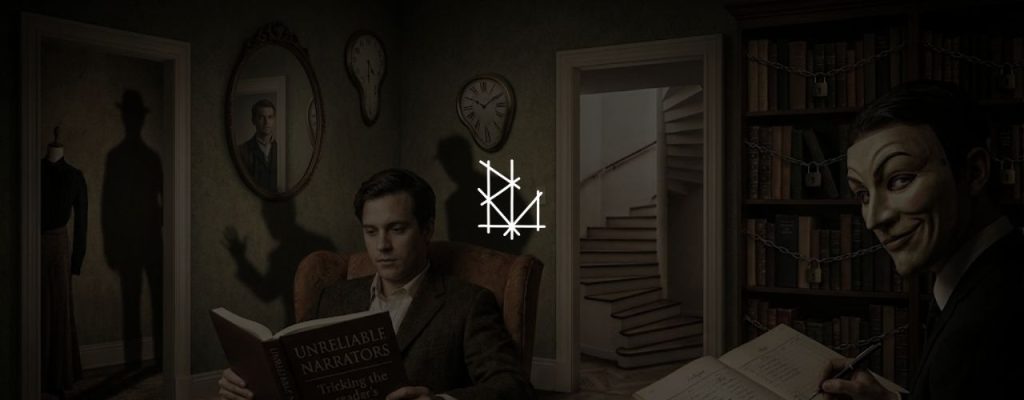
Unreliable narrators are one of the most powerful tools in horror and dark fiction. By distorting reality, omitting truths, or outright lying, unreliable narrators trap the reader inside a fractured mind where certainty collapses and fear thrives.
Unreliable Narrators and the Illusion of Truth
An unreliable narrator presents a version of events that cannot be fully trusted. In horror, this technique becomes especially potent because fear often emerges from ambiguity rather than clarity.
The reader is forced to question every detail, every memory, and every confession. Is the supernatural real, or is it a projection of a collapsing psyche? This uncertainty creates a lingering sense of dread that persists long after the final paragraph.
How Unreliable Narrators Trick the Reader’s Mind
Unreliable narrators manipulate perception through subtle narrative distortions. They rarely announce their deception. Instead, the reader slowly realizes that something is wrong.
- Contradictory memories and shifting timelines
- Selective omission of critical events
- Emotional bias disguised as objective truth
- Confessions that arrive too late to trust
This technique mirrors real psychological mechanisms such as denial, repression, and dissociation, grounding the horror in recognizable human behavior.
Unreliable Narrators in Psychological and Supernatural Horror
In psychological horror, unreliable narrators blur the line between sanity and madness. In supernatural horror, they raise a more disturbing question: what if the narrator is wrong about reality, but the horror is still real?
Stories involving horror and supernatural themes often use unreliable narrators to deepen isolation, paranoia, and existential fear.
Why Unreliable Narrators Work So Well in Horror
Horror thrives on uncertainty. An unreliable narrator removes the safety net of objective truth, forcing the reader to actively interpret the narrative.
This narrative strategy transforms the reader into a participant, constantly questioning what is real and what is fabricated. The fear does not come from monsters alone, but from the realization that perception itself is unstable.
Many dark narratives and books explore this structure to create long lasting psychological impact, including stories centered on isolation, cults, forbidden knowledge, and cosmic insignificance.
I invite you to check my books
Orto https://www.amazon.com.br/Orto-English-Raphael-T-Maio-ebook/dp/B0FWMN6KZJ?ref_=ast_author_mpb
Grake Hills https://www.amazon.com.br/Welcome-Grake-English-Raphael-Trindade-ebook/dp/B08JRY74FG?ref_=ast_author_dp&th=1&psc=1