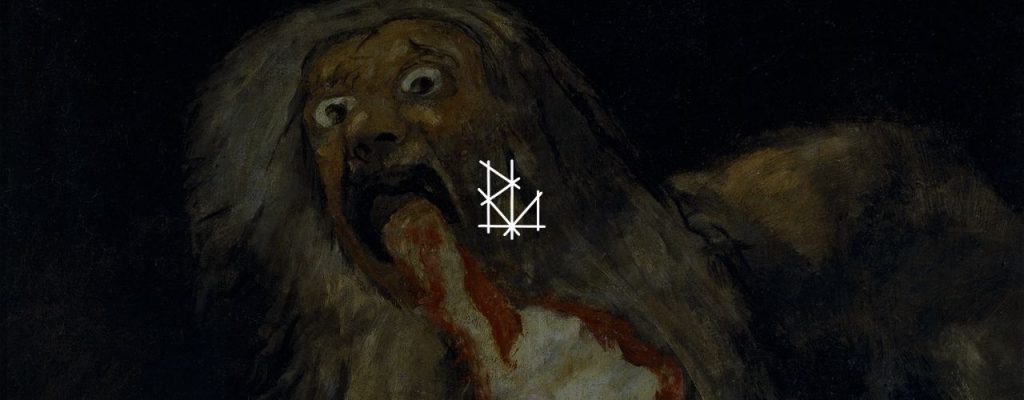
Few artworks confront evil as directly as Saturn Devouring His Son by Francisco de Goya. This painting does not ask for interpretation it assaults the viewer. There is no mythic distance, no poetic veil. Only hunger, fear, and a violence so intimate it feels almost witnessed rather than painted.
This is not a story about gods. It is a story about human darkness. And if you are drawn to horror that feels personal, claustrophobic, and psychologically invasive, this image is a doorway you cannot unsee.
Saturn Devouring His Son and the Horror of Absolute Power
The keyword Saturn Devouring His Son is inseparable from one idea: fear of losing control.
In the original myth, Saturn consumes his children to prevent being overthrown. But Goya strips the story of symbolism and replaces it with raw instinct. His Saturn is not divine. He is feral. Naked. Wide-eyed. Desperate.
This is horror without fantasy.
What makes it terrifying
- Eyes bulging with panic
- Hands clutching flesh, not authority
- A body devoured not in ritual, but in terror
The Black Paintings: When Art Becomes Psychological Horror
Saturn Devouring His Son belongs to Goya’s Black Paintings, a series created directly on the walls of his home, the Quinta del Sordo.
These works were never meant to be seen.
They were private. Confessional. Almost pathological.
Within this context, Saturn Devouring His Son becomes less a mythological scene and more a window into a collapsing mind. Goya was old, isolated, disillusioned by war, betrayal, and human cruelty.
The painting feels less like creation and more like exorcism.
Why Saturn Devouring His Son Feels More Disturbing Than Modern Horror
Modern horror often relies on spectacle.
Goya relied on truth.
There is no background. No setting. No explanation.
Only darkness and consumption.
Unlike traditional horror imagery, this painting removes distance. The figure looks real. The violence looks immediate. It feels less like a demon and more like a man who crossed a line and can never return.
That is why Saturn Devouring His Son remains so unsettling centuries later.
Cannibalism as Symbol: Fear, Time, and Self-Destruction
Saturn is also associated with time.
Seen through this lens, Saturn Devouring His Son becomes something even darker:
- Time consuming youth
- Power destroying its own future
- Humanity devouring itself
This is not just a painting about violence. It is about inevitability.
And inevitability is one of the purest forms of horror.
Saturn Devouring His Son and the Roots of Psychological Horror
This painting anticipates modern psychological horror in ways few artworks ever have.
There is no monster design. No lore. No jump scare.
Just a moment frozen in irreversible madness.
This is the same kind of dread found in stories where the threat is internal, where the true enemy is obsession, fear, or the mind itself, a tradition that lives on in dark fiction and unsettling narratives.
If this kind of atmosphere resonates with you, you may also feel at home in stories where the supernatural is ambiguous, the danger intimate, and the horror slow-burning.
Why This Painting Still Matters
Saturn Devouring His Son endures because it does not age.
It speaks to:
- Tyrants afraid of losing power
- Parents destroying what they claim to protect
- A world trapped in cycles of fear and violence
Goya did not paint a god.
He painted us.
Horror Without Escape
There is no moral lesson at the end of this image. No redemption. No balance restored.
Only darkness swallowing itself.
That is why Saturn Devouring His Son is not just disturbing it is unforgettable.
I invite you to check my books
If you are drawn to stories where fear grows slowly, reality fractures, and something watches from the dark, explore my novels:
The darkness does not end with the painting. It only changes shape.