
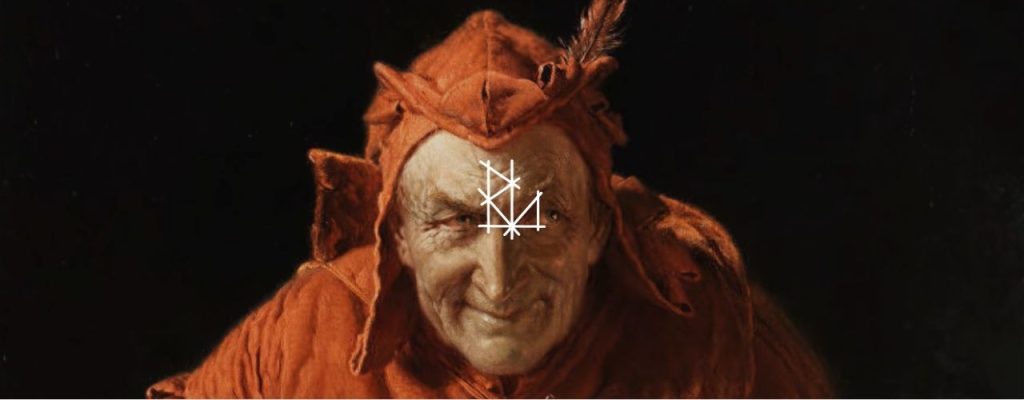
The painting we are looking at is called Mephisto, created in 1895 by the German artist Eduard von Grützner. It may be one of the most unsettling depictions of evil precisely because it refuses the usual visual shortcuts. There are no horns, no wings, no monstrous distortions. Instead, the demon appears as an elderly man in an elegant red suit, leaning toward the viewer with an expression that is hard to name and even harder to forget.
If you enjoy the kind of horror that feels plausible, intimate, and psychologically invasive, this painting hits a nerve. It is not a spectacle of hell. It is a portrait of temptation that could sit beside you, smile politely, and start negotiating.
Mephisto (1895) and the Human Face of Evil
Most depictions of demons rely on distance. They look inhuman, so you can keep them “over there,” safely outside your world. Grützner does the opposite. His Mephisto looks uncomfortably familiar, like someone you might pass on the street or someone who might approach you with a friendly voice and an offer that sounds reasonable.
That choice is not random. Mephisto is short for Mephistopheles, a figure tied to the Faust myth, a story that spread across Europe and evolved over centuries. In the legend, Mephistopheles is not a brute that attacks. He is the one who proposes. He places the contract on the table. He waits for you to sign.
The Faust Myth: Why Mephistopheles Does Not Need to Threaten You
The story begins with Faust, a brilliant and ambitious man who feels hollow despite his knowledge. He studies astronomy, medicine, theology, philosophy, and still cannot reach what he truly wants. That is the crack in the soul where Mephistopheles steps in: not to terrify, but to propose a deal.
The terms are simple and devastating. Faust is promised everything for a limited time: knowledge without limits, renewed youth, pleasure without restriction, any experience he can imagine. In return, when the time ends, his soul no longer belongs to him. This pact became known as the Faustian bargain, one of the most influential ideas in Western literature.
From Marlowe to Goethe: The Deal Gets Deeper
The myth first appeared in popular German texts in the late 16th century, then grew more complex. Christopher Marlowe (1592) made Faust a tragic figure torn between desire and guilt. Goethe (1808) elevated the story into a symbol of modern restlessness: Faust does not chase only pleasure, but meaning itself, risking everything to escape the limits of the human condition.
Mephistopheles Is Not Lucifer: Why the Intermediary Is Worse
A crucial detail often gets blurred in pop culture: Mephistopheles is not Lucifer. He is an intermediary, a messenger, an agent who acts on behalf of others. His power lies in presentation. He does not force. He does not need violence. He wins through seduction, logic, and the ability to mirror your secret desires until they sound like destiny.
How Artists Depicted Mephistopheles and Why Grützner’s Version Feels So Wrong
Many artists tried to capture Mephistopheles, each emphasizing a different fear. Some portray him as grotesque and supernatural, complete with wings and theatrical menace. Others show him as a strategist, calm and patient, letting humans destroy themselves with one “reasonable” choice at a time.
Grützner’s difference is stark: he drags the demon down to earth. He gives him age, a body, a personality, and the kind of expression you might recognize in a confident stranger. In this version, evil is not a creature from the underworld. It is a person with manners.
A Close Read of the Painting: The Red Suit, the Feather, the Lean
In Mephisto (1895), the figure stands and leans slightly forward, as if he has just spoken to you and is now waiting. His body turns subtly to his left, and his gaze follows, implying something or someone beyond the frame. That implied off screen presence creates tension: it suggests a conversation already in progress, a decision already circling you.
Why the Clothing Matters: Seduction Disguised as Theater
The most striking element is the clothing. He is dressed entirely in red: a fitted tunic buttoned up to the neck, carefully detailed, topped by a matching hat and an exaggerated feather. At the time, such feathers were not common in everyday wear. They suggested costume, performance, courtly display. The implication is chilling: he is not an animal. He is a role, played perfectly.
This aligns with the literary tradition. In classic versions of the myth, Mephistopheles has no fixed form. He transforms and disguises himself. In some passages, Faust even asks him to appear more pleasant, more human. Grützner paints that request as a visual truth: a demon who does not need to look monstrous because fear is not his main instrument.
The Expression: Not a Smile, a Proposal
His expression is complex. It is not an obvious grin, but there is a subtle curve to his lips. He seems to enjoy the moment when temptation is placed in front of you, when doubt is planted, and when you begin to rationalize. This is not a predator chasing prey. This is a negotiator waiting for consent.
Why This Depiction Is So Disturbing: Evil as Normality
What truly unsettles is not just the color red or the theatrical costume. It is the humanity. Grützner refuses the classic symbols of evil. There is no fire, no distortion, no obvious marker that tells you “this is a demon.” Instead, you get an ordinary face, a confident posture, and a gaze that feels familiar, almost social.
And that is the trap. In real life, temptation often arrives through real people with real faces. It speaks in a reasonable tone. It offers shortcuts. It makes the worst choice feel like a logical next step. This is why the painting functions like psychological terror: it suggests evil does not need to reveal itself to control you.
Faustian Bargain as Modern Horror: What You Trade for “More”
The Faust myth survives because it is not only about selling your soul. It is about what you are willing to give up to obtain what you desire most. Time, love, integrity, peace, identity. The contract does not have to be supernatural to be real. That is why Mephisto is timeless: he is the voice that turns hunger into justification.
If you like fiction that weaponizes myth and dread, you might also enjoy a book that leans into atmosphere, suspicion, and the sensation that something is bargaining for you in the dark. Or stories where the supernatural is never fully confirmed, yet always felt.
FAQ: Mephisto, Mephistopheles, and the “Scariest” Painting of Evil
1) Who painted Mephisto (1895)?
The painting is attributed to Eduard von Grützner, a 19th century German painter known for character scenes and a vivid, theatrical sensibility.
2) Is Mephistopheles the same as Lucifer?
In the Faust tradition, Mephistopheles is typically portrayed as an intermediary rather than Lucifer himself, a figure who negotiates and collects rather than rules.
3) What is a Faustian bargain?
A Faustian bargain is a deal in which someone trades something essential, often their soul or moral integrity, in exchange for power, knowledge, pleasure, or “more” than ordinary life can offer.
4) Why does Grützner’s Mephisto feel more frightening than monstrous demons?
Because he looks human. The painting suggests evil does not need to be obvious to be effective; it can be charming, patient, and socially acceptable.
5) What makes the red costume and feather important in the painting?
The theatrical red attire emphasizes performance and seduction over brute force, aligning with the mythic role of Mephistopheles as a persuasive negotiator rather than a violent monster.